Guided painting
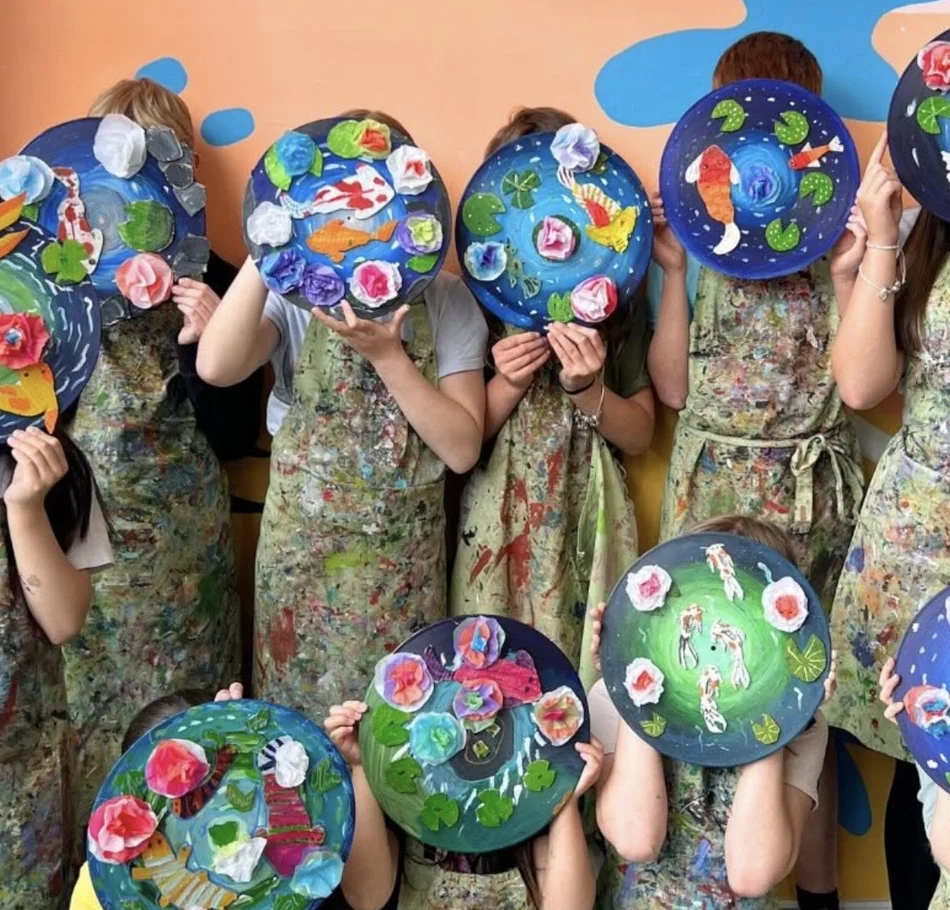
Step by step, with the birthday child as the lead artist. Every guest makes their own piece to take home.
Art birthday parties · ages 5–12
Planning a birthday in Warsaw? Make it truly special. The children paint, create and celebrate together under a professional artist — and every little guest goes home with their very own masterpiece.
What's included ↓
yours to take home!
What's included
Step by step, with the birthday child as the lead artist. Every guest makes their own piece to take home.
Materials, aprons and table covers arrive with us — and the mess leaves with us. Nothing for you to set up or scrub.
Hosted in English, Polish, or both — whatever feels right for your guests.
Simple, all-in pricing
Up to 10 children · 2 full hours
+130 PLN for each additional child
Deposit: 700 PLN (non-refundable)
Payment: the full amount at least 24 hours before the party
Where parties happen
💡 Hosted in English, Polish or both — and the food is yours to choose: bring your own cake, drinks and treats. Coffee for the grown-ups is on us 🙂
Choose a workshop
Tell us what your child is obsessed with right now and we'll build the party around it — or pick one of these, the ones children ask for again and again.
Ages 5–7
Every child designs their own fairy house and the whole garden around it. First comes the mushroom house: a white tower with round windows and a door, topped with a clay cap in the colour they choose, covered in white spots. Then the children lay out the garden: a stepping-stone path, a little stick fence, flowers, a pond with a water lily and tiny lanterns. Finally they make the fairy who lives there, from a wooden peg, with a pipe-cleaner dress and sparkly wings. Each child decides where the house stands, where the path goes and what the fairy looks like, so no two gardens are ever the same.
Children build a unicorn mask from scratch — shaping it with their own hands, then painting and decorating it exactly how they like best. A rainbow tissue-paper mane, paper flowers, glitter, stars and a golden horn: every choice is theirs, so no two masks come out the same. Craft and painting in one, and everyone leaves wearing their own.
The workshop children ask for most. We start with the story, then everyone paints their own deer — warm browns, a pale muzzle, white spots added one at a time, rosy cheeks. A tissue-paper flower crown goes on above the ears at the end. The mask is big and properly made, and it leaves the studio with the child who made it.
A whole house from scratch. Children design the structure first, then furnish it room by room — furniture, wallpaper, a patterned roof, a terrace with climbing plants and a garden around it. It is the project that asks them to think before they build: where the bed goes, how you get inside, what you can see from the window.
Inspired by Laurel Burch, the American artist whose animals are never one flat colour. Children cut and paint every part separately — head, body, patterned wing, fanned tail and long legs — filling each with dots, stripes and circles of their own. Then the pieces are joined so the wings and legs actually move: a bird that flaps and walks.
Everyone paints the animal they love most, on a real stretched canvas. We start with the shape and the eyes, then build up the fur in layers, mix the exact browns and creams for their own pet, and finish with a collar, a tag and a background all their own. Acrylic on canvas — a proper little portrait to hang at home.
The workshop that looks best with the lights off. Children shape a dome from crepe paper, hang iridescent film beneath it and add long curled tentacles in purples and blues — then a small light goes inside. Switch it on and the whole jellyfish glows from within. It goes home that way, ready to hang above a bed.
A three-storey castle built from cardboard from scratch. First the structure, with towers and battlements, then the cone roofs and hand-painted flags — and then the best part: furnishing it. Every room gets its own wall colour, a chequerboard floor and handmade furniture, from a canopy bed to a table laid with flowers. A castle the dolls can genuinely move into.
Paint your own fish. Every child gets a ready-made sculpture and brings it to life — bright colours, bold shapes and playful patterns of their own, worked around a form they can turn in their hands. It dries standing on its own base, and goes home as a one-of-a-kind piece rather than a picture to file away.
A mushroom built from nothing. Children shape the cap and stem in papier-mâché layer by layer, wait for it to harden, then paint it in bright, cheerful colours — classic red with white spots, or whatever they decide a mushroom should look like. It stands up on its own when it's done.
A castle on the sea floor, built from cardboard from scratch. Children cut and slot the walls together first, raise the towers and the battlements, then roll a tall turret and crown it with a cone roof in whatever colour they pick. After that it all goes underwater: the sea painted straight onto the walls in blues and greens, clay coral and seaweed pressed on in bright colours, shells, beads and sequins for treasure, and a whole seabed on the base around it. Building, painting and modelling in one workshop — and it comes home standing up.
Ages 8–12
Every project in this group can also be painted on canvas — it depends on the theme of the workshop and on what you would prefer. Just tell us when you book.
An old Turkish technique that looks like magic every single time. The paint never touches the paper first: it goes onto the surface of thickened water. Children flick it from the brush drop by drop and watch the colours spread into circles, then draw patterns through them with a stick — waves, spirals, flowers. Finally they lay a sheet of paper on the water and lift it off with the pattern printed on it. No two prints are ever the same and none can be repeated, so each child makes several and goes home with a whole collection. A calm, slightly hypnotic workshop about colour, patience and a light hand.
The most ambitious build we run, and the one children talk about afterwards. The group designs a whole settlement together and then splits the work: the domed main station, the habitat pods, the greenhouse with real seedlings growing under a clear dome, solar panels, a weather mast, and a rover with wheels that actually turn. Everything is cut from cardboard and bottle tops and tube offcuts, joined with flexible pipe tunnels so the modules link into one base, then set into a landscape of red-painted rock and dust. The engineering is the lesson — a dome has to be cut as segments, a pod has to stand, a tunnel has to reach — and because each child builds a different module, they have to agree on how it all fits together. It works beautifully as a team project for a whole group, and it is a particular hit with the boys — this is the one they ask for by name.
Children paint their own round pond — deep, swirling water in blues and greens first, then koi carp cut from paper, painted with their own patterns and layered on so they look like they are swimming. Tissue-paper water lilies and green pads go on last, sitting proud of the surface. Painting, collage and texture in one, and no two ponds come out alike.
Clay, canvas and craft in one project. Children paint a sky across a real canvas, then model bright balloons and a little house from clay, press them on and join them with twine — so the house genuinely floats above the clouds. A picture with texture that lifts off the surface, and everyone takes theirs home.
Children paint their own version of Van Gogh's Starry Night, in acrylic on canvas. We start with how he laid the paint down — short, thick strokes that gather into swirls — then build the starry sky, the spiralling cloud, the dark cypress and the sleeping town with its windows lit. A patient workshop with a real payoff.
Vermeer's portrait, made almost entirely without a brush. The background comes first — black, scraped through with gold and bronze — and everything after that is paper. Children match the shades: a dozen blues for the turban, warm beiges for the face, gold and copper for the dress, then tear them into pieces and lay them like mosaic. A workshop about patience and about looking: to match a shade you have to study the original properly.
The city after dark, on a real stretched canvas. The sky goes on first, blended wet-on-wet: deep blue at the top falling through violet and orange into a band of gold along the horizon. Once it is dry the skyline goes over it as a crisp black silhouette — the bridge, the towers, the rooftops. Then the best part: the lights. Hundreds of tiny white dots for windows, street lamps, the strings of bulbs looping along the bridge cables and the stars above. Blending, silhouette and layering in one afternoon, and the canvas goes home ready to hang.
Real clay that hardens on its own — no kiln, nothing to collect later. Children roll out a slab and press things into it for texture: leaves, petals, lace, the edge of a fork. Then everyone shapes their own piece — an animal-shaped trinket dish, a decorative plaque, a friendly little monster, a botanical relief, a hanging ornament or a small clay house — and finishes it with their own patterns and stamped details. Once it has dried it can be painted, and it goes home solid enough to actually keep rings and hairpins in. Works best from about seven, when fingers are patient enough for the fine detail.
The full version of the underwater castle, taking a whole afternoon. The cardboard structure comes first: walls with battlements, a gate and several towers of different heights, finished with cone roofs and flags. Then the whole thing sinks — deep water painted across the walls and the base, swaying seaweed, coral and anemones modelled in clay, shells, pearls and sequins scattered as treasure, and a complete seabed around the castle: stones, starfish, shoals of little fish and Ariel herself. A workshop for older children, since the cutting, gluing and detail take patience — but a whole underwater scene goes home, not a single object. (Reference photo — an example of the project, not a piece made in our studio.)
A picture built entirely from torn and cut paper, with no brush at all. Children choose the subject and the artist to work after — a bird in the bold shapes and patterns of Laurel Burch, a folk-art animal in warm reds and blacks, a Matisse-style cut-out, a Klimt full of gold and circles, a city skyline. We look at how that artist uses colour and shape first, then everyone draws their own outline and fills it piece by piece: patterned papers, plain colours, tiny circles and triangles laid like mosaic until the whole shape is covered. Slow, absorbing work with a striking result — and every picture comes out different, because no two children pick the same papers.
A drawing technique that is as much about unwinding as about the picture. We start with the line: a free, unhurried scribble across the page, drawn without planning it. Then comes the part that gives neurographic art its name — every sharp corner where two lines cross gets softened into a gentle curve, one at a time, until the whole tangle starts to feel calm to look at. After that we add circles and fields of colour, layering felt-tip, ink and pencil until shapes emerge that nobody designed on purpose. Everyone leaves with their own drawings and a set of hand-made cards. No drawing experience needed — the technique works precisely because there is nothing to get right. (Reference photo — an example of the technique, not a piece made in our studio.)
A bird built from nothing and finished like a real object. Children shape the body from crumpled paper and tape, then cover it in papier-mâché layer by layer — smoothing as they go, because every lump shows once the paint is on. Once it has hardened it gets primed, and then the markings go on: a dark hood, patches across the wings, a long striped tail, every bird different depending on the one its maker has in mind. Last comes the mounting — two dowel legs set into a wooden block, so it stands properly on a shelf instead of lying in a drawer. Patient work across the whole session, and the result looks like something from a gallery shop.
This one uses every minute of the two hours and then some — the papier-mâché has to harden before it can be painted and mounted, so we allow extra time and the price differs from the standard party rate. Ask us when you book.
A big, ridiculous fish built around a balloon. Children paste papier-mâché over the balloon layer by layer and leave it to harden, then pop it — and what is left is a hollow shell light enough to hold in one hand. After that it becomes a fish: fins and a tail cut from cardboard and slotted in, a cardboard tube for the gaping mouth, and two huge googly eyes that give the whole thing its character. Then the painting, which is where they really let go — hot pink and turquoise, loops and dashes and rows of dots, glitter circles along the flank. Nothing about it is subtle, and that is the point.
This one uses every minute of the two hours and then some — the papier-mâché has to dry between stages, so we allow extra time and the price differs from the standard party rate. Ask us when you book.
A tall, elegant, faintly ridiculous bird built around a glass bottle. The bottle gives it weight and a ready-made body; everything else the children add — a long curving neck built up from rolled paper, a sharp beak, and papier-mâché smoothed over the whole thing until it reads as one creature rather than a decorated bottle. Once it has hardened they paint it in bold blocks and bands: orange against green, cobalt and grey stripes, whatever combination they like, laid on thickly so the brushwork shows. The last step is the one they all wait for — a pair of sunglasses, which turns a sculpture into a character. They line up on a shelf looking thoroughly pleased with themselves.
This one uses every minute of the two hours and then some — the papier-mâché has to harden before it can be painted, so we allow extra time and the price differs from the standard party rate. Ask us when you book.
An autumn house with a pumpkin for its walls. Children build the pumpkin itself from papier-mâché over a balloon, so it comes out round, hollow and light, then paint it deep orange with a painted stem on top. The house part is the fun: a proper arched front door that opens on a hinge with a little brass knob, windows cut into the sides, and a cardboard staircase of stacked steps leading up to the threshold. Inside they furnish a tiny room — curtains, a rug, a pot plant, a flameless tealight that makes the windows glow at dusk — and outside they add paper flowers around the walls. It goes home as a lamp, a doll's house and an autumn decoration all at once.
This one uses every minute of the two hours and then some — the papier-mâché has to harden before it can be painted and furnished, so we allow extra time and the price differs from the standard party rate. Ask us when you book.
A classic still life built out of paper instead of paint alone. Children cut each apple from card and cover it in torn pieces — book pages, gingham, polka dots, patterned scraps — then paint over the top in thick strokes of red, yellow and green, letting the print show through so every apple ends up patched together from a dozen different papers. The basket is woven from torn kraft paper and real twine, the leaves are cut and veined one by one, and the whole arrangement is layered onto a black ground so the colours ring out. Everything stands slightly proud of the surface, which is what makes it worth looking at up close.
A working-looking outpost that actually lights up. The centrepiece is a great dish antenna, built from a papier-mâché bowl on a girder mast and rimmed with real fairy lights, angled up at a starfield the children paint themselves — deep black, scattered stars, Earth and Mars, and a satellite trailing dashed signal lines across it. Beside it they build the domed mission control, furnished inside with desks and screens and lit from within, plus solar panels, a power station wired with real cable, and a console flashing MESSAGE SENT. Astronaut figures and hand-lettered signs go in last, and the whole base sits on a rocky landscape with a stepping-stone path. It is the one the girls ask for — and the lights going on at the end is the moment everyone remembers.
Make birthday invitations in minutes — five designs, your details, ready to print or send on WhatsApp. Free, even if the party is at home.
Good to know
Everything parents usually ask before booking.
Up to 10 children is 1699 PLN, then 130 PLN for each additional child — so 12 children is 1959 PLN. We suggest at least 6 so the group energy is right.
Yes. The package is 2 hours, and you can add more time: 150 PLN for an extra 30 minutes, or 300 PLN for an extra hour. Just tell us when you book.
Absolutely! We'd love to show you around and plan the best celebration together. Get in touch and we'll find a time that suits you.
A 700 PLN deposit reserves your date. The deposit is non-refundable and counts towards the total price. The rest must be paid at least 24 hours before the party. For example, for a 1699 PLN party you pay 700 PLN when booking and 999 PLN at the latest the day before the party.
At the latest 7 days before the party. We prepare the materials for each child individually, so we need the final number a week ahead.
Absolutely, we love doing it! Tell us who or what your child is into right now, and we'll suggest lots of creative ideas for turning it into an art project.
Two to three weeks ahead is ideal, especially for weekend slots which fill up quickly.
Food is not included, so you can bring exactly what suits your guests — cake, drinks, snacks and decorations. We bring the art, aprons, creative chaos and coffee for the grown-ups 🙂
Comfortable clothes that are allowed to get a little colourful. We provide aprons, but paint loves to wander.
Yes — a digital invitation card for your guests is included in the price. We design it around your party's theme and send it over, ready to share. Printed or hand-crafted invitations can be arranged separately.
Book a birthday party
Send us a few details and we'll get back to you to confirm the date and all the fun. Booking 2–3 weeks ahead is ideal.