
3 Summer Art Projects to Do at Home — Pasta, Flowers and Stones
Art for Kids · Wed 5 August
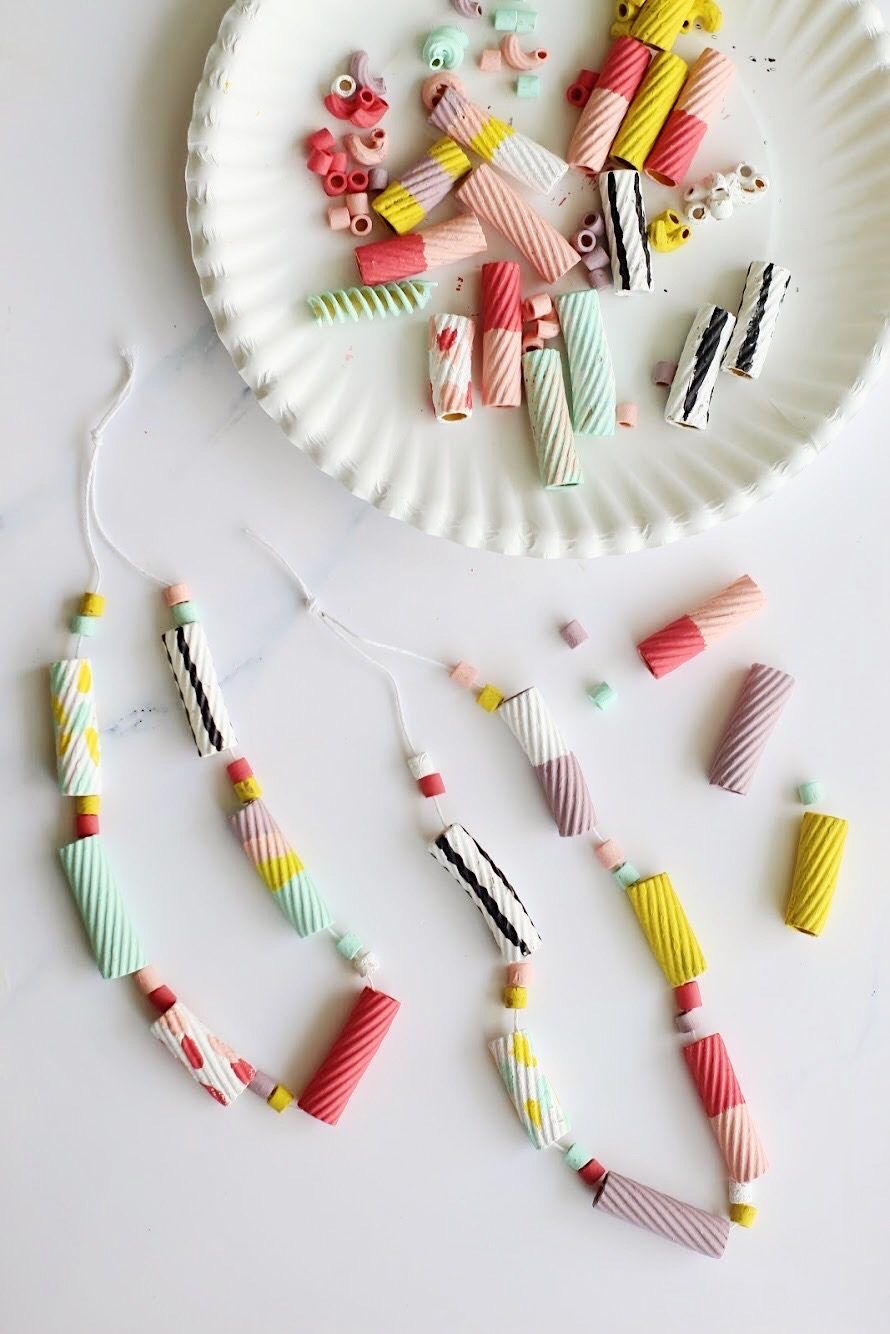
Summer afternoons at home have a way of stretching out. Here are three projects we come back to again and again — one at the kitchen table, two that start with a hunt outdoors.
What links them is that the material costs nothing. A handful of dry pasta, a few flowers from the verge, stones off the ground. The making is the whole thing.
Fair warning: there's real paint and real glue in all three. Put something down on the table first.
1. Painted pasta necklace
You'll need: dry tube pasta in two or three shapes (penne, rigatoni and small macaroni), acrylic paint, a thin brush, a paper plate, and cotton cord or thick string.
Tip the pasta onto a paper plate and paint it. Then leave it to dry — about twenty minutes for acrylic.
Here's the trick that makes all the difference, and you can see it in every bead in the photo at the top of this page: don't paint each piece one solid colour. Paint half a tube coral and leave the other half raw. Paint one end yellow and the other end white. Give a few pieces black stripes, and a few a scatter of dots. That two-tone colour-blocking is exactly what makes them look like beads from a shop instead of painted macaroni.
Then thread them. Alternate one long piece and one little round one — long, short, long, short. That rhythm is what makes a necklace look designed rather than random. Tie the ends and it's ready to wear.
Which paint: acrylic. It covers pasta in a single coat and dries hard and bright. Poster paint works for younger children — cheaper, and it washes out of clothes — but it needs two coats and stays a little chalky.
Ages: a four-year-old can thread big rigatoni onto a shoelace. The fine striping suits six and up.
2. Crowned by the Garden
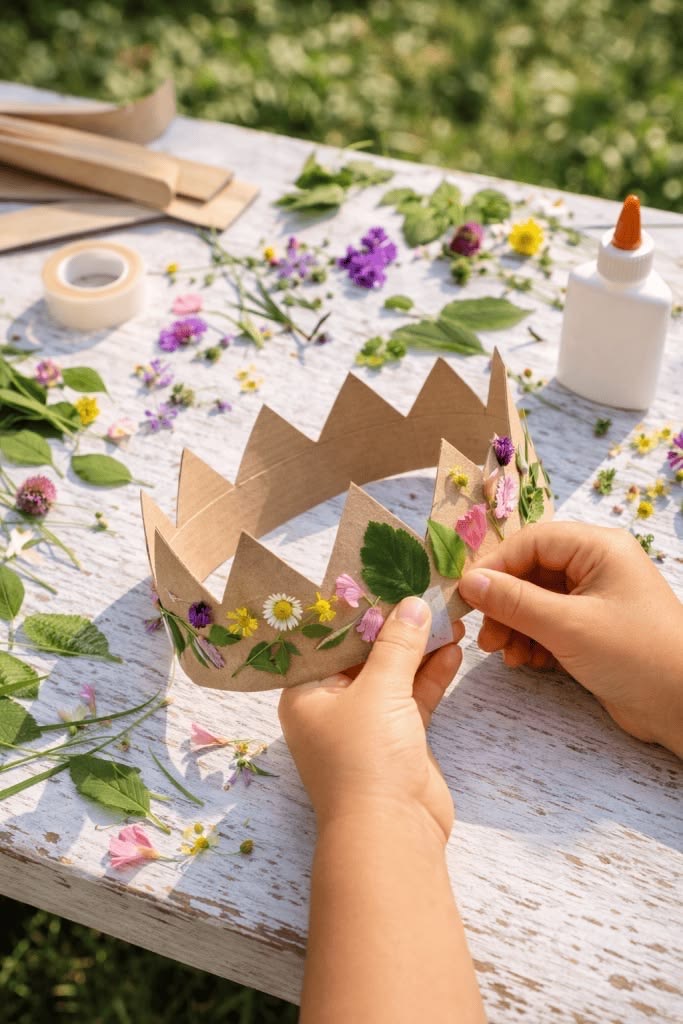
You'll need: a strip of cardboard cut from a box, scissors, PVA glue, masking tape, and whatever happens to be flowering nearby.
Cut a strip about 6 cm tall and long enough to go round your child's head with a few centimetres to spare. Cut a row of zigzag points along the top edge — that alone already reads as a crown.
Then go and collect. This is half the project, and the better half: daisies, clover, buttercups, small leaves, seed heads, grasses. Flat flowers glue best. A big rose head is too heavy and will drop off within the hour.
Back at the table, lay everything out on the cardboard before the glue comes out. Move things around, try a different order. Then glue: a blob of PVA on the card, press the flower down, hold for a slow count of five. Tape the two ends together to fit the head.
One honest note: fresh flowers wilt by the next day. If you want the crown to last, press the flowers between the pages of a heavy book for two or three days first, then glue them on. Otherwise treat it as a one-day crown — which is, genuinely, part of the charm.
3. The Greengrocer Hiding in the Gravel
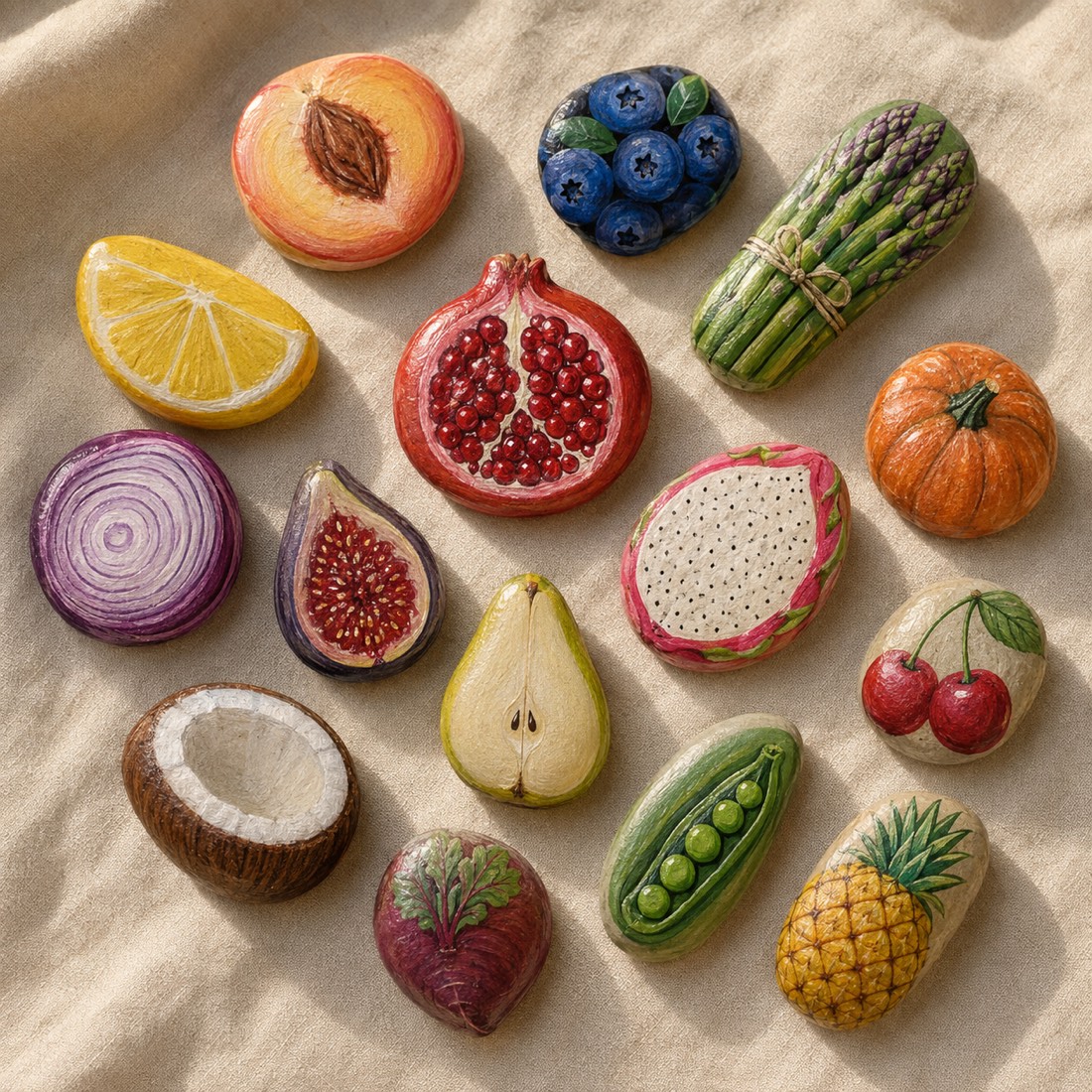
You'll need: smooth stones, acrylic paint, a medium and a fine brush, and acrylic paint pens if you have them.
The hunt comes first, and it's the real skill here. Don't pick up any old stone — go looking for the shape. Long and thin is a carrot. A fat oval is an aubergine. A teardrop is a pear. Turning a stone over and working out what it wants to be is a genuine artist's skill, and it costs nothing to practise.
Wash them, dry them, then paint the whole stone one flat base colour and let it dry before any detail goes on top. Details last: seeds, the pith of a lemon slice, a green stalk.
Cut one open. The best stones on the tray above aren't whole fruit — they're the inside: a pomegranate's packed seeds, the pink middle of a fig, peas lined up in their pod. Halve a real fig, set it beside the stone, and paint what's in front of you. That's where this turns from craft into drawing from observation.
Which paint — and here it really matters:
- Acrylic is the right choice. It grips the stone, covers in one or two coats, gives strong flat colour, and is waterproof once dry. Small pots of craft acrylic are cheap and one set lasts for years.
- Poster paint and tempera don't work well on stone. They sit on the surface, rub off on hands, and the first drop of rain takes them with it. Fine for a single indoor afternoon, not for anything you want to keep.
- Acrylic paint pens are worth having for the detail. Seeds, pips, the stripes on a watermelon rind — far easier for a child to control than a fine brush.
- Put a white base coat under any yellow or red. A grey stone swallows those colours completely. White underneath, and a lemon actually looks like a lemon.
Finish with a coat of clear acrylic varnish or Mod Podge if the stones are going to live outdoors or get properly played with.
Then play with them. A basket of stone fruit and veg turns into a greengrocer's shop, a memory game, or a counting set — which is why this is the one that tends to outlast the afternoon it was made in.
And if the rain sets in
We run projects like these properly, in English, in small groups. Get in touch and we'll help you plan one.
Ready to start creating?
Bring your little artist to a class where English just happens.
Book a class